
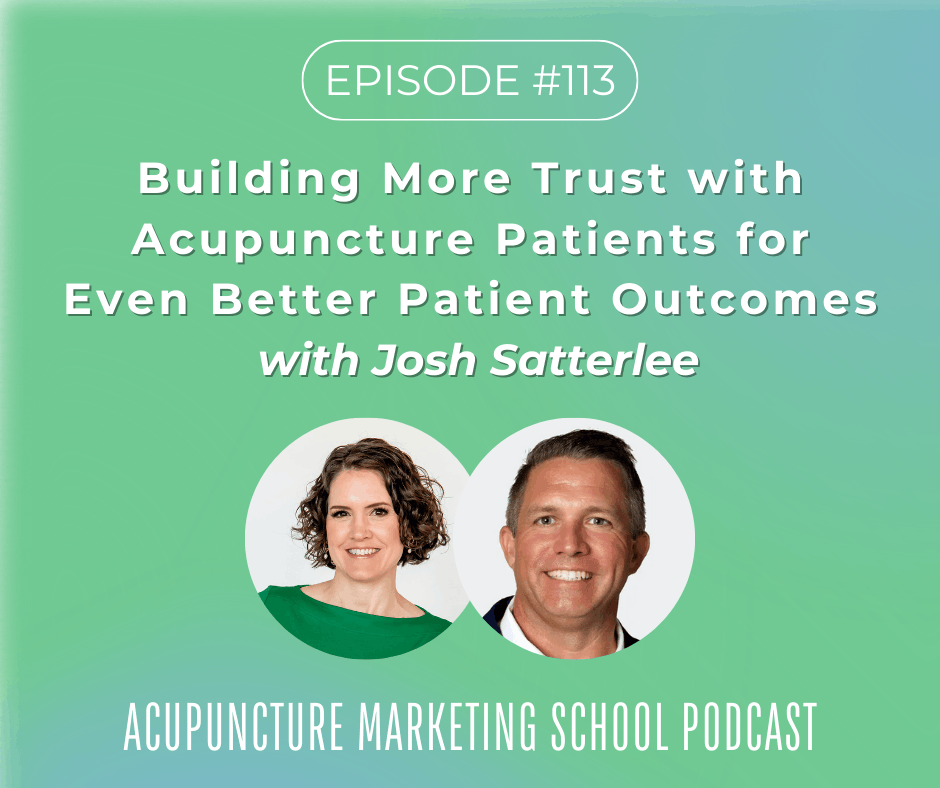
Building a strong patient relationship begins long before they arrive at your acupuncture practice.
In this episode, I’m joined by Dr. Josh Satterlee, chiropractor and founder of TrustDrivenCare. Josh shares the deeply personal story that inspired him to launch TrustDrivenCare, plus his mission to make sure that every patient feels comfortable and heard. We dive into how to create deep trust with your patients even before their first appointment.
What you’ll learn:
- The importance of marketing in establishing trust with your patients
- Small, thoughtful systems that make a huge impact on patient experience
- How acupuncturists and other wellness professionals can use communication to build more loyal patients
Find it quickly:
- 2:53 – Meet Josh Satterlee
- 3:46 – The story behind TrustDrivenCare
- 11:25 – How marketing creates trust with your patients
- 15:15 – Taking steps to establish connection
- 19:28 – Effective communication strategies
- 24:11 – Communicating across channels with TrustDrivenCare
- 32:04 – Integrating with Jane and other EMRs
- 35:20 – Improving reactivation numbers
- 41:05 – Josh’s definition of success
Mentioned in this episode:
- Follow Josh Satterlee on Instagram: instagram.com/drsatterlee
- Josh Satterlee Website: trustdrivencare.com
🎙️ Listen to Episode #113: Building More Trust with Acupuncture Patients with Josh Satterlee
💙 This episode is sponsored by Jane, a clinic management software that’s here to make practice life a little easier. Join in on the free webinar “Understanding AI in Health and Wellness” to learn how AI can benefit your practice.
Ready to get started? Use the code ACUSCHOOL1MO for 1 free month at jane.app.
Subscribe to the Acupuncture Marketing School podcast on Apple Podcasts or Spotify
💖 Love the podcast? Help other acupuncturists find the podcast by leaving a review here.
Transcript:
Michelle: Welcome to the Acupuncture Marketing School podcast. I’m your host, Michelle Grassic, and I’m here to help you get visible in your community. Take marketing action with confidence, and get more patients in your practice and more money in your pocket every week. We both know you’re a talented, passionate acupuncturist and that acupuncture has the power to change lives.
So let’s dive right into this episode and talk about how you can reach more patients.
Hi there. Welcome back. Today I’m talking with Dr. Josh Satterley, chiropractor and founder of Trust Driven Care, a company focused on transforming patient communication and connection in healthcare. In this episode, Josh shares a deeply personal story about losing a close friend that later inspired his mission to fix one of the biggest problems in healthcare.
Patients not feeling truly heard. We talk about how building trust starts long before a patient ever walks into your office. And how small, thoughtful systems like a simple text message or a photo of your building can make a huge impact on the patient experience. We also dive into what real trust looks like in marketing, and how acupuncturists, chiropractors, and other wellness professionals can use communication to build stronger, more loyal patient relationships from day one.
I hope you really enjoy this episode with Josh. Today’s episode is sponsored by Jane. All in one practice management software that I use at my practice. If you’ve been curious about how AI is showing up in healthcare and wellness, but aren’t quite sure where to start, you are not alone. And Jane has created something just for you.
They are hosting a free 20 minute webinar called Understanding AI in Health and Wellness, and it’s designed for practitioners with some clear, thoughtful answers to the very common questions that people are asking right now about ai. Like, how can I be sure that AI features are secure and compliant? How can AI help me in a clinical setting and how do I introduce AI to my patients?
So you’ll come away feeling more confident about how AI can actually support your work and create some extra time in your day. The webinar is hosted by members of Jane’s AI scribe team, so you’ll be learning directly from the people who are building these tools for real world use in clinics like yours.
It’s on October 30th at 12:00 PM Eastern Time, but if you can’t make it live, a replay will be available for everyone who registers. So you can sign up for the webinar through the link in the show notes. And if you’re ready to get started with Jane, don’t forget to use the Code Accu School one Mo for a free one month Grace Period on your new account.
All right. Let’s get into this episode with Josh. Hi, Josh, how are you?
Josh: Hey, I am good, Michelle. How are you?
Michelle: I am good. Before we get started, do you wanna introduce yourself to the audience?
Josh: Absolutely. Hello audience. It’s good to see you today. My name’s Josh Satterley. I’m a, um, chiropractor by license out in beautiful Henderson, Nevada, which is like a suburb of Las Vegas.
Been a Cairo for, whew, it’ll be 19 years in December, so longer than I thought it would be. I love being a chiropractor. I love, I really love healthcare where we can make a change. Like right now, you know? And I think acupuncture falls into that. I’ve unfortunately gone through like cancer battles with my parents and like when they’re like, Hey, we’re gonna give you this medication and we’ll know six to eight weeks from now if it’s working, it’s crappy.
So I love the fact that it’s like, Hey, your pain was a eight and now it’s a five. Clearly that’s progress. You couldn’t lift that weight. Now you can. Clearly that’s progress. I don’t know why everybody doesn’t do it. Yeah,
Michelle: it’s a, it’s a good question. And you also run a business called Trust Driven Care, which is pretty comprehensive and amazing.
So I’ll let you, I’ll let you run through like a summary of that.
Josh: Yeah. So it’s kind of two parts. I’d love to share the story of how it started, but basically. A few years ago, I had a friend call me and he said, Hey, I have low back pain and you know, you’re a chiropractor. And this person was like very special to me.
He was like a mentor, businesswise, and just, just a very clear headed, like wise person, you, you kind of come across in life. And I was like, oh yeah, well let’s get you set up. And so we found a chiropractor in his area. He lived in like Tucson, Arizona, and uh, let’s find a chiropractor area. So he went and he said, yeah, it helped, but it didn’t really do great.
Then I said, okay, well, you know, sometimes these conditions maybe just need strengthening and stuff, so go to a physical therapist. Right? So he was diligent about it. He went to a physical therapist and basically said the same thing. Yeah, it was, it was good. Wasn’t great. You know, I still still have pain and being a driven person, like he, he went to another chiro, then he went to his general practitioner, um, was like, Hey, I still have pain.
I’m trying to do it, but can I get some. Can I get some pain meds? Because like the chiropractor’s taking the edge off, but it’s not like, you know, still tough sleeping and all this stuff. Then he went to a, got a referral from there to an orthopedist who sent him to a hip specialist. ’cause they were like, oh, the pain’s coming from your hip and then went to urgent care and all this stuff.
Well, this all took about a year, right? As he is bouncing back and forth and the eighth provider or seventh provider looked at him, was like, you, you don’t have back pain, man. You have. You have colon cancer and it’s metastasized to your spine. I was like shocked. I was blown away. And so I went to visit him and I’m sitting there talking to him in his last few weeks of life, and I may get emotional here, Michelle, I apologize.
And I’m like, what, what happened? Like what? Like how did this hap, like how did we get this far down the path and nobody heard you? And he’s like, oh. And he said something that totally stuck with him. He is like, oh, you know, well everybody was really busy and I, I didn’t wanna take too much time. I was like, yeah, but like what other things did you tell him?
And he is like, well, like I told him I was taking a lot of ibuprofen and that’s probably why I had like red blood in my stool. You know, it was wrecking my gut and I couldn’t eat. So that’s why I lost like 35 pounds in a month. And, uh, they were doing a good job, but I told him like, I still, you know, when I lay down, I still have pain at night.
And that’s why I asked for the pain meds. And I’m like, oh my God. Do you’re, these are three gigantic. Textbook examples of red flags for cancer. And what really irked at me was this wasn’t a failure of like chiropractors, right? It wasn’t a failure of like one profession, which you could be like, oh, we need to, our profession needs to improve at that aspect.
This is like all forms of healthcare, nurse practitioner, md, orthopedist, chiro, physical therapist, like everybody, right? And it was finally caught by, I think a nurse practitioner at an urgent care, like that’s who sent him for an MRI. I was like, how is the system failing this person? This dude was a very clear speaker, an engaging individual, very low anxiety with healthcare.
So it wasn’t like he’s going in scared. There was no language barrier, you know, like, so this was, of all the cases we could all succeed with, it’s sitting in front of us, right? And when he talks about three blatant crazy red flags for cancer, why didn’t everybody, anybody hear him? And so. He didn’t get an MRI until almost a year later, at which point it was like stage four and it had metastasized, right?
And I’m like, God dang it. Why did we fail him? So when he passed away, I was pretty, a mixture of like angry and also like, we have to find some solution here. And so I dove into a bunch of research off PubMed and like, where are the failures in healthcare communication? What’s the problem here? Like there’s a fundamental issue, not, not like, oh, well, if you just add these questions to your history, it’ll improve.
Like, we’re well past that, right? And so I start looking and it’s clear, like every source, every journal talks about these problems. Like doctors don’t listen and patients don’t feel connected and they, they don’t feel like they can actually present why they’re there. They, the number one complaint is, I don’t feel like anybody ever listened to me.
And if we’re not listening, then how the hell can you do a history? Like, that’s fundamentally based in listening to your patient, right? And so if, if that’s flawed, everything from that point forward is flawed and it’s like, okay, so the whole sy like, no wonder we have a problem, is like we’re not stopping and saying what’s the core issue?
You know, you’re acupuncturist. So I think you guys are really good at the subtle signs of things. Like, I mean, just how you guys do pulse evaluation, right? Like I’m a, I’m just lightly familiar with this ’cause we, at my chiropractic college, we also had a traditional Chinese medicine. Acupuncture school.
Michelle: Oh, cool.
Josh: Very nice. Yeah. And um, and so those subtle signs are, are important, but that also goes with communication. Like if you’re hesitant to tell me something, right? If you went on a date with somebody, you probably do want to ask them at some point if you’re gonna get in a relationship, like do you have any credit card debt and are you addicted to any drugs or alcohol?
Right.
Michelle: Let’s run through a couple red flags.
Josh: Right? Yeah. And you wanna know those before you decide to like get married. However. You don’t typically ask those before the bread basket drops gets dropped off on your first date, right?
Michelle: I mean, some people are all business
Josh: and I commend them, but what do you think?
How, what’s the accuracy of the information you get at that point too? Truth, right?
Michelle: Right. Yes. Why you have, have you earned it for them to tell you the truth?
Josh: Exactly. But in healthcare, we don’t have that choice. We have to ask these questions, these red flag questions. Before the bread gets dropped off, meaning it’s the first five minutes of the first time you’re meeting somebody.
And so I think, what’s the level of trust that person has with you? And if it’s low and you ask them a tough question, like for me with low back pain, like do you ever have incontinence? When you stand up and you feel pain, when have you ever lost control of your bowel or bladder? If you don’t trust me, like what’s the accuracy of that information?
You’re gonna say, no, no, that’s never been a problem and therefore I will as your healthcare provider go, okay, well then I don’t need an MRI. When in fact I do need an MRI, which would’ve revealed other things. So this, there’s this huge problem. And so after I saw the problem, I said like, how do we, how do we overcome that?
And basically, I think we should like quadruple our efforts at making a connection with the person before they ever step into your office. Okay. And then when they’re, when they’re in your office. That first visit can’t be overstated. The importance of that first impression of everything you do then cannot be overstated because the other catchall, and I’m sure you’ve probably had this as a provider, is if they come in with anxiety and they don’t trust you, a lot of times here’s how you’ll know you’ve broken through with trust, like you connect with them, is it go like they’ll look left and right and be like, Michelle, I didn’t want to tell you this on our first visit, or I know you asked me at our first visit, but I actually do have.
You know, I do have some incontinence or I do have this, have you ever had this with a patient? Like they reveal some big, I think what’s happening there, and I think every provider has it. I think you’re finally like getting above that level of trust with them and they’re like, okay, I trust that you’re, you’re actually caring for me and that you’re gonna listen.
So I’m gonna kind of reveal this just like on that third date, if they go, listen, I know you asked about credit card debt and I said no, but I do have some, you know?
Michelle: Yeah.
Josh: Yeah. So if we can just take that and move it to the front. I. Because how many people fall off before we ever make that connection?
Michelle: I was gonna say, yeah.
’cause there’s no guarantee that we’re gonna make it to the third or the fourth visit or whatever that person needs for that. That trusting space to tell you that.
Josh: So how can you solve it? And I will say like, this is called the The Acupuncture Marketing School. Marketing is, you could think of it as just our early forms of communication with our patients.
Right. And true marketing I think would. Outside of healthcare, they say marketing should drive sales. Well, sales in our world is, I think treatment plan and completion. That’s a true sale, right?
Michelle: Compliance. Yeah. I know
Josh: compliance, adherence, like all these words that are like robotic in nature. But really I think it’s like, if I believe that you are the solution, why would I ever leave you?
And we can see this. Um, so, so the second half is when I realized this. It’s really hard ’cause you’re busy and you have a million patients and you’re going bumping in and out and you’re, you know, jumping here and there and, and there’s a business to run and there’s all these things. The overall solution is create an automated system that does a lot of the heavy lifting for you.
And that’s how we get into, we do two-way text messaging and we do two-way appointment reminders, um, from EMRs that maybe don’t have that right. And we want those messages to come from your office phone number, not some random number. All these microscopic little deposits in the trust, trust account. And then when they come in, can you do the right things in front of them to make that connection?
And then when you say, Hey, it’s gonna take us, you know, 12 weeks of this, you know, or look at, we have one client, she, she’s an acupuncturist and she almost purely treats infertility. That might be a two or three year journey. Right? Five years for God’s sakes. And how do you get them to be like, I know it hasn’t happened yet, but let’s, let’s keep trying.
If they don’t trust you, if you didn’t do the right things, if you didn’t build a relationship, they’re moving on.
Michelle: You know, it’s so interesting because, um, very few people talk about how marketing can build trust either through like repeatedly showing up and sharing a message or through education. But I have always found this phenomenon that the people who find my practice through Instagram, which is really where I share my face the most, and I share videos.
I’ll do like fast motion videos of cosmetic acupuncture. ’cause I want people to see like, it’s not scary. Like this person’s napping while I’m putting needles in their face. They get a face massage and then they wake up like rumpel still skin or something, but like six years younger. They just wanna share.
Yeah. Like it’s a, it’s actually a great experience. Like acupuncture’s wonderful. And it, that process, they get to see me, they get to see my associate melody. So I feel like people who come into the office, they make an appointment that found us through Instagram. Have so much more. It’s, it’s like they feel like they already know me and they’re, they already bought in, right?
Because I’m talking about, okay, well you need this many treatments and here’s why and here’s something else that could help. And did you know like if you have this kind of period pain, blah, blah, blah. So when they arrive, I’m like, oh, okay. You know, I have a little spiel for new patients and like acupuncturist cumulative.
You need this many treat. And they’re like, yeah, yeah, yeah. I remember from Instagram. Like the reason they decided to come in was basically that educational marketing built trust and made them feel good, and they’re like so happy to be there. Whereas then you get people who, and my favorite example is their spouse wants them to come in and they have like very little desire for acupuncture.
They wanna feel better. They’re like, ah, my husband or my wife kind of made me do this, but they, their exposure to me and to acupuncture is zero. Right? So then I’m trying to sell them on this concept that like, I don’t know if your spouse knew this, but you actually need to come like eight to 10 times.
Right. It’s such a different dynamic in the treatment room. And yeah, I think that if you’re, it’s almost like do your marketing and your education on the front end before they’re even your patients. And then when they arrive in your office, they are already like your biggest fans. They’re like, tell me what to do.
Josh: Absolutely. Fantastic point. And even for you, I would say based on like the, what we see in our clinics, we work with, take whatever is the best connecting point that they talk about and advance it, push it forward in your, in your workflow. So, for example, I always challenge our, our, we do some live training and stuff with this, right?
And so here’s, here’s the challenge. I would say to everybody on there, if you want to have a great patient experience at the first visit, think about this. If your grandmother was in town and she was gonna meet you for lunch and you said, Hey, I’m done with patients at noon. Come to my office and she says, okay, well I don’t have a cell phone, so I guess I’ll see you there.
What actions would you take? To ensure that she actually steps into your office?
Michelle: Uh, so many, if you’re really asking, I mean, I would probably make sure she has my address and I would double check and I would call her and I would be like, depending on the person, like, did you do a drive by? ’cause sometimes people will be like, I actually drove to your office yesterday, just see what parking was like.
And now I’m here today and I feel good about it. I would do that with my grandma.
Josh: So if you were to do that with every patient. So let’s say the steps, you automate this, but they’re gonna get a map link, and maybe this is three days before the appointment, two days before the appointment, you send a picture and say, this is what the building looks like from the outside.
Especially if, I don’t know if you’ve ever been to an appointment, but like sometimes buildings from the street you’re on are like, you look on Google Maps and it shows the front of the building, but what you’re actually looking at is only the view from the parking lot side, and it looks nothing like that.
I remember when my wife was pregnant, we had to go to an O-B-G-Y-N and there’s like a, it’s like a long building with an elevator on either end. We went up one elevator only to find, like you had to walk all the way across the building. And so like send a picture and say, grandma, use this elevator. And you mentioned parking, like in how many healthcare practices is parking a big deal?
And remember, like as a chiropractor, people aren’t moving great. Hence why they’re hiring me, right? So I don’t wanna be like, so I wanna say like, park in these spots, they’re reserved for patients or, or this is the closest spot to my office, right? We would take all these steps for somebody we really, truly care about because your grandma already has trust with you and you have it with her.
So why not push that forward in your, um, thing? Because you’ve pulled into your office a thousand times, right? You could do it with your eyes closed for God’s sakes. That’s their first time. And you’re a little point about like, oh, I drove by Google just released some statement that over the age of 65, like 42% of people report driving by a healthcare office.
In the days leading up to the appointment. So that anxiety is in everybody. It’s real. So imagine what they would feel like if they got a message three days before going, Hey Michelle, I know you have an appointment in a few days, but I just wanted you to know this is what it looks like from the outside and here’s where to park.
Michelle: I have a confession.
Josh: Yeah, go ahead.
Michelle: I can’t, I can’t parallel park. That’s terrible. I live in a town of 6,000 people, so like what is. The need to parallel park. There’s literally, if there’s five cars, that’s traffic. So, but that means that when I go into nearby cities to like have lunch with friends, I know I’m not parking on the street.
So I am always doing this extensive research on like, where are the nearest parking garages and when are they free? When are they open and close? Do I have to bring cash? It’s ridiculous. I could just learn a parallel park, but I’m not,
Josh: we have a client that has a Google Review. They got a one star Google review.
It was purely said, they didn’t tell me that I had to pay $2 for parking. I can’t believe the lack of customer service and blah, blah, blah.
Michelle: That’s a mean. It is. That’s a mean Google review. I think that person’s gonna be a business owner in another life, I
Josh: hope. Yeah. However, what’s important is that’s easily solved, right?
And if that person is the only person to review you like that. How many other people felt upset about it, kind of bad and just didn’t take any action. So we try and balance these two things of like, how can it work for your office? Meaning can we automate this? Can we produce a system? Can we do these things?
And then also, you still have to be a great human. You still have to offer great service. Like you can’t get away from that.
Michelle: So when you are talking about sending these automated messages ahead of time, are they email, are they text? Are people opting in or opting out? ’cause I could see that, you know, I have some grumpy patients who are like, do you need to send me so many reminders?
And I’m like, well, uh, yeah, because lots of people get five reminders and they still no show. So, so I’m sending them all right.
Josh: Yeah. So there’s some really good research around this and it says that, um, they compared sending a single person 10 emails in a series. Versus sending somebody one email, one text, make one phone call, and one social media message.
Okay. Four messages compared to 10. Which one do you think did a better job?
Michelle: I hope it’s four. ’cause that sounds like less work.
Josh: It is, yeah. Those people reported feeling like they were much better connected to and that the person cared.
Michelle: Interesting because it was multiple channels. So it channels, it doesn’t have to do
Josh: with quantity.
Yeah, that’s right. So think about it like this. Who name someone you care about? Let’s say your mom. Okay. Your grandmother. How do you communicate with her?
Michelle: Text? Mostly text.
Josh: Okay. Except how do you communicate with her on Mother’s Day? Do you just send a text saying, happy Mother’s Day? Ah, nope. I, or do you change it up and do another form of communication, like writing a card or calling her going in person?
Yeah. Now you don’t have to do that every day, and 99% of the time you’re just texting her. Right. But what is the version of Mother’s Day to your patient? It’d be that first visit, right. So if you do it, then you never have to do it again. And if you just think about how many actual individuals you have in your practice over a year for a chiropractor, you know, in a, in a month, if you’re getting 50 new patients, that’s crazy.
So 50 50 calls, I could do that over the course of a month, right? And if that meant that the person went instead of five visits, they went to 15 visits with me, would you be willing to do it? You know?
Michelle: Sure.
Josh: Because I only have to make one phone call and it’s not even connecting with them. The attempt seems to connect with people.
Oh, Michelle tried to call me. That’s awesome. And I actually got her text.
Michelle: So just leaving a message
Josh: is better is sufficient. Now, I will tell you, connecting, calling and text and email and all those things are better, but the attempt, so here’s another one. I would highly recommend if you want Reactivations to work, and if you want Google reviews, here’s a secret little ninja.
Move the night of the first exam. Send a message just saying that you’re checking in. Don’t promise any therapy. Don’t ask for any diagnosis. Just send a message checking in. So for me, this would be like, Hey Michelle, it was a pleasure meeting you today. I just wanted to check in and see how you’re doing.
I didn’t say, I wanna check in about your low back. I didn’t say I wanna treat you for neck pain. All I’m saying is you as a human matter so much. I was thinking about it now that’s hard to do. Right? And I noticed this comes from anecdotal research of my own practice. I, for a while I had a, a consultant and he said, call every new patient and I do that.
One day it took me an hour and 10 minutes to call on my new patients because they all freaking answered. It’s like the worst problem in the world, but
Michelle: it’s my nightmare. You know what I noticed to be on the phone at the end of the day,
Josh: right after you’re trying to get home? And my wife’s like, where are you?
But here’s the kicker. I just happened to look at that day. I was going through some things and I was looking for something on my calendar, and just the way our calendar worked, I could see that there were those six patients, right? And now we’re like three months later. I look and I noticed the average of those patients, so our average in general was that people came for 10.6 visits.
Okay? The average for those six people was 14.6 visits In 90 days. I’d added four visits on average to every person, and I think it has to do with the fact that I connected, like I actually called and I talked to them. The most common response was, oh my God, I’ve never had anybody do this.
Michelle: Taking a quick pause to remind you about today’s sponsor, Jane, the All-in-one practice management software I use at my practice, Jane is hosting a free 20 minute webinar called Understanding AI and Health and Wellness, all about helping practitioners make sense of ai.
What is secure? How can it help in clinical settings and how to introduce it to your patients? It’s led by members of Jane’s AI scribe team, so you’ll get answers from the experts who are building these tools. It’s on October 30th and a replay is available if you can’t make it live. You can sign up through the link in the show notes and use the Code AQ School one mo for a free one month Grace period on your new Jane account.
Alright, let’s get back into Josh’s episode
Josh: to make it easy on you. Here’s where automation and text messaging helps send a text saying, Hey, I’m just checking in. What we do is we have a way to schedule a message. So when you’re, when I’m done with your initial exam, it could be 10:00 AM I schedule it to go out at a random time, like 7:04 PM so that the patient thinks, oh my gosh, the last thing he did when he left his office was think about me.
And then if you really wanna pour like jet fuel on this, include. I pre-write 90% of the message. It’s already written in my system, but I add a little detail of something they shared in the visit that never made it to their paperwork. So like the most common one is I say, do you have a dog or cat? And they go, oh yeah, I have a dog named Scruffy.
So if I put in there, Hey Michelle, I just wanted to check in and see how you’re doing. By the way, give Scruffy a scratch for me. It’s a win. And what’s the number one complaint in all the research around communication? Nobody ever listened to me. So I just proved to them. I listened to the point where I wrote down Scruffy’s name.
Right.
Michelle: I mean, I would be super impressed with that as a patient. I’m always impressed when people remember my pet’s names. Uh, I’m like amazed.
Josh: Yeah. Pets are really good activities are doing that day. Like, Hey, how did lunch go? And over in Rochester or whatever, you know, whatever town you said you were driving to, anything that you include that wasn’t on their paperwork.
’cause if it’s in their paperwork, some people go like, oh, you just pulled that in. And I’m like, no, I, I took the time.
Michelle: I, wow. Even they’re overthinking it. Like, please just be impressed that you got a message.
Josh: But I like, that’s a great point. If you bought a car and three days later you just got a message from the salesperson saying, Hey, Michelle, just wanna see how the new car’s working out.
It would feel good, right? If you bought a mattress, if you got a refrigerator, like it doesn’t matter what, it just feels good when people check in because it’s. A trust building exercise.
Michelle: It does emphasize, especially when someone has sold you something, that it was not just about the sale, right? It was not about like, okay, I made my money done and dusted.
I never need to speak to you or hear from you again. And obviously it’s a little different with patients ’cause we need follow up, but I still think it emphasizes like I’m acknowledging that you’re a person. This was not purely transactional. That’s always nice
Josh: and, and a lot of people might say, might be listening ’cause we, I get some hate mail.
Oh, text does not. HIPAA compliant way of communicating. Okay? It’s not compliant for transmitting patient information. But I’m not doing that on specific, I’m connecting to the person and how to, 99% of people con connect with everybody in their life through text message. I’m not saying, Hey Michelle, how’d the alopecia respond after our treatment?
I’m not saying that
Michelle: right? Yes.
Josh: I’m just saying how’s
Michelle: your, how’s your incontinence? Right. I hope your husband sees this message. Exactly.
Josh: All I’m saying is I just wanna check in and see how you as a person are doing. It reassures them that I do care about them and that we have a relationship moving forward.
Just like after that first date, you would probably send a message saying. Hey, it was great. You know, it was great hanging out. I’d love to do it again or something.
Michelle: Right. If you, if you wanted it, if you wanted there to be a second date.
Josh: Yeah, that’s right. We would do that. Or in the case of healthcare, a 10th, 12th, 18th, 25th date.
Michelle: I am. I’m so curious if, ’cause from what I know about trust driven care, it’s this specialized software and everything is together. Correct. Like it’s in one platform. But I guess my question originally was now I’m leading us down this rabbit hole is. Are we actually texting on a phone or is there like software that we’re using on our desktop where we’re typing in the message and the response?
What? Like what does that look like?
Josh: So one of the things that I believe in, number one, lemme address like is all in one. Yes. Because the person that you’re emailing is the same one that you’re texting is the same one who’s gonna call. Is the same one that might leave you a voicemail is the same one who might leave you a review on Google is the same one you’re gonna ask for a review on Google is the same one who might send you a DM on Instagram?
Oh my God, that’s exactly what I need. Can you do it? Like, so why now?
Michelle: You’re drowning in messages?
Josh: Well, yeah, you’re drowning in platforms. But what it really looks like is Michelle would connect, you just take ages. Your parents would probably connect with a healthcare office through phone. To me, to them.
That’s the way you start a relationship, right? To me and you, I would probably go to their website, ask a question, send an email to 25 year olds. They perceive dms, Instagram, dms, as a legitimate way to connect with a business. Our parents couldn’t, or grandparents couldn’t perceive that. Right.
Michelle: Sometimes it’s hard for me to perceive that.
Josh: Yeah. But here’s one thing I do know. It’s incredibly rare if I, I don’t even think I’ve ever seen it ever, that somebody connects in all those ways. They establish one channel and go, this is how I like to do it.
Michelle: Okay. What’s most convenient for them?
Josh: Yeah. Now how their brain works with text. For example, people may communicate 99% of the time with text, but if they wake up and they’re really worried or something, they may call, right?
Because it functions well for that. But yeah, you’d be surprised. So anyways, so, and the reason we put it in, we just put that all into one, what we call a conversation thread is. It has to also work from the, from your office. It can’t, you can’t have to log into eight different places to follow this conversation and like, how’s this person doing it?
You have to be able to do it quickly. And if we can do it through a text-based program, you can automate some things. You can send links, you can send pictures that work to build trust and to day. Most of the time you’d be doing it like on a desktop. So just like you have your EMR pulled up, the next tab would be trust driven care, so you can do your communication side.
There’s also a mobile app. That works great, like one-to-one, or if I’m answering a call or if I’m out on the road, you can do it there. But most efficient is desktop. Just like your EMR.
Michelle: Gosh, I’m trying to wrap my head around this. So you’re connecting all of these different platforms in this one place, including.
Being able to call and text patients through your office number. Because I think you mentioned earlier that it’s important that the office, it’s actually from your office number. It’s not like a randomly generated phone number. ’cause I don’t answer those numbers. I let them go straight to voicemail.
Josh: Yeah.
And I think that you’re not alone in that. We use your phone number because that’s the one that your patients connect to. And as much communication as we can move there. So like, you know, there’s a lot of EMRs that send out reminders, but through a random number. And I, I don’t like that feeling. It’s effect, like it’s, it’s works to get information out, but I wouldn’t say it’s communication.
Communication means that they can respond and I can respond and we have like a commonality and it strips that away.
Michelle: Yeah. And you mentioned that there’s two-way texting and two-way re appointment reminders, which I think is pretty rare because most appointment reminders are like, do not respond, like I’m just vomiting this information.
Your appointment is tomorrow at two. Don’t ask any questions.
Josh: Yeah. So I’ll go back if I want to take you on a date, and if I send a message, Michelle, you are meeting me at this place for dinner, 6:00 PM Do not respond. This inbox is not monitored. Right. Don’t,
Michelle: don’t ask any questions. If you’re gonna be five minutes late, don’t tell me.
Josh: Yeah. And then you’re like, wow, that feels like a really warm entrance to a date. I think we need to take that perspective with our patients because again, we’re not interested in just that one visit. We’re interested in establishing a relationship. So, yeah, two way reminder. So what that means is you and I, I think both use Jane.
I love Jane Jane’s, my, my homie, my road dog. It doesn’t have two-way appointment reminder. So what we do is we just sync with your calendar and say, we can look at the appointments, and then we just say, okay, well if, if Michelle has an appointment at four o’clock, send her a reminder at 2:00 PM. We do it two way through that.
So we do that automatically behind the scenes. ’cause you don’t need one more thing of pulling down information and uploading and all that. So we just, we, uh, sync with your Jane account.
Michelle: Gotcha. Yeah. I was gonna ask if Jane syncs pretty smoothly with your software. ’cause I noticed on your website it says trust driven care is.
Is not a part of Jane. Yeah. So I, I assume you must have people who think that like your software is built into Jane or something like that,
Josh: that that’s what you want is like a, when it’s so smooth, you go, oh, well these are the same thing. And I’m like, well, they’re not. Yep. And I wanna like, oh,
Michelle: you must be owned by Jane.
Josh: Exactly. Yeah.
Michelle: Do you know off the top of your head, are there other acupuncture EMRs, like Unified Practice or ACU Bliss? Any of those sound familiar? IN
Josh: No.
Michelle: It’s probably on your, probably on your website under integrations or something, but people could look it up
Josh: as a Cairo. I, I love Jane and I was like, Hey, we’ll just, you know, offer it to Jane Kleins.
And I was really surprised by how many acupuncture clinics we have as clients and how many very large acupuncture clinics we have as clients. And, and it comes down to like. Everybody does it. Almost always the same. ACU, chiro, pt. Like if I just, if I took a message out and go, what kind of clinic is this?
You should be able to like, I don’t know, but they just care about their patients. Be like, perfect, you know.
Michelle: So if people were curious about integrating with their EMR, they could like contact your team and then discuss like what that would look like. Gotcha.
Josh: Yeah. And I will say this, like we get asked all the time for integrations and so our general rule is like, I’m a chiropractor, so I would say I have chiropractor money, I don’t have venture capital money.
So if they’re like five people from a specific, if five people get together, it’s worth it for us to build an integration for them. It’s not worth it if we have one. Like a simple practice is that one we get asked for in the mental health space all the time. We just haven’t had enough people using it.
’cause everybody that’s like, oh, I’m using simple practice like, but I’m mo moving to Jane. I’m like, okay, well then I’m not gonna build an integration for a software you’re leaving, you know? Yes.
Michelle: Yeah. And you guys have a relatively small team. It seems like there’s six or seven of you. So I mean, just like building out integrations is, it sounds easy when you’re not a software person.
Josh: Yeah. Like right, but it’s like 90, you just slap
Michelle: that
Josh: together. 90. Yeah, it’s at least 90 days. And I’ll just tell everybody, like the biggest thing is. Do you do like joint manipulation in your training for acupuncture?
Michelle: Um, we did not, but there are some people who learn like Advanced TWE Knot and that might incorporate it.
Yeah. Okay,
Josh: perfect. If you say Advanced TWE Knot, I say an adjustment. The, the difficulty is teaching software to know that those are, you can treat, those are the same, but when you’re talking to Michelle’s clients, say Tweet on when you’re talking to Josh, say adjustments, and people are like, oh, how, how long can it take?
There are 7,000 things you say that are different than the ones I say. You know, like when you get into software, you’re like, right,
Michelle: yes.
Josh: Birth date, date of birth, DOB, you know, all these things. And I’m like, and some people are like, I wanna put my preferred name, I wanna do age, I wanna do this. I’m like, right on every one of those is a little line of code, you know?
Michelle: Yes. We’ll get that back to you in 90 days.
Josh: Exactly. Yeah.
Michelle: But you do have lots of acupuncture clients already on board and, okay. Well, thank you so much for being here. Was there anything else you wanna add before we, we sign off?
Josh: Yeah. Um, I just love talking to you so we can go on longer, but one thing I did bring up before we rec record or we hit record was you said that a lot of people are interested in Reactivations and was it Google reviews?
Is that
Michelle: the other? Yeah, always, always interested in Google reviews for sure.
Josh: I will tell you that, you know, we serve hundreds of accounts, right? I could show you. So we look at this ratio of how many patient visits do you have in a week, and then how many Google reviews do you get? And it varies on what type of healthcare you have, but this is all like internal data.
But when we’ve analyzed that data and we can find clinics that are out of sku, meaning for how many patient visits they see, they have a very low number of Google reviews or. We send out. So we do automated reactivations. We just wait, we put every one of your patients in it. We just wait for them to get 90 days from their last appointment and we send ’em a message.
So it’s just a rolling thing. It never stops. Instead of like, run this list, send them a message, all that, uh, that’s for the birds
Michelle: manual.
Josh: Yeah. You have other things to commit to. So anyways, we, we, we do that, we call it our infinite loop. Just everybody’s in reactivation program and the only way to get out of it is to come in.
That’s basically
Michelle: it. You literally, they cannot escape this one. Yeah,
Josh: right. But, um, I’m in a reactivation loop with my wife too. Like she can’t get out of it. So anyways, when we see those numbers skewed, I was like, why isn’t this working? And, and some of our clients would call us like, Hey, I sent out a reactivation and no, and nobody came back in and this and that.
And, you know, we dove into the numbers. Really what it comes down to is those people do not work hard to create a relationship on the front end. In the first three visits, they’re very sterile. They’re not connecting to the person, they’re making the assumption that only the diagnosis and, uh, applicable treatment matters.
And I would just tell you that is a recipe for disaster. And the patients that we go into that, like when we call them or they call into our support, are warm and welcoming. They’re genuine. The Reactivations work really good because people want to come back into your office. So we had one individual who called me and said, reactivations aren’t working and this and that.
And I was like, oh, that’s, lemme look into it, right? And so I’m asking my team and they said, oh, is it so-and-so? And I was like, yeah. And they said, oh, he just made one of our support agents cry. He said, you’re an idiot. You don’t know what you’re doing. You’re making this overly complicated. I was like, interesting.
I didn’t have a great call with him either. And you know, people usually clean up for the owner and like they’ll be nicer to me than my lowest ranking person. But I’m like, oh. And so then I talked to somebody else who happened to be in his town and she’s like, oh, I get patients from him all the time that say, oh yeah, he just treated me like crap.
Michelle: Weird.
Josh: I know. I’m like, why would you go into healthcare if you like that? But you know, one of my mentors said like, you never know what they’re dealing with. Maybe he’s going through a messy divorce. Maybe he is dealing with a sick kid or whatever. However, I could show you on a graph where he lands, and you could say, I bet that guy’s a jerk, just because it’s such a stark difference to how well Reactivations work and Google Review requests work.
People if they like you, they want to review you and they want to be reactivated, and they’re like, oh, it’s not, I don’t have any pain. It’s, I wonder what else Michelle could help me with. I remember when I was in there last time, she said she also treats headaches. I’ve kind of been taking a lot of Advil lately.
I wonder if I could, if she would, you know, help me out with that, or I’m nervous about getting any sort of going to this med spa. But she said that she does this, you know, facial work and it’s like, I should try that, right? Because they have a relationship with you. By the way, here’s how you know you have a good relationship too.
I said like they reveal something. Here’s the other one. Have you ever had this where a patient comes in, they ask you about some completely unrelated form of healthcare. They’re like, um, I’m thinking of, um, you know, I don’t know what would be totally unrelated in your world, but like, I, I need to get a hip replacement.
Which one should I use? You know, and you’re like, I’m not a surgeon. Well, who should I go to? And you’re like, I don’t, I think what those people are saying in that moment is, you have become my filter for all healthcare. You are my trusted advisor. So it’s just like you would go to your banker and say like, Hey, who should I get a mortgage through?
Or, which firm should I invest in or invest with? Because what you’re saying is financially I trust you. Why don’t you advise me on these other things? Right.
Michelle: You know, yesterday I had a patient ask me out of the blue, she was like, my bank is closing, and I’ve been with them for 47 years and I’m wondering who you use.
And so we were, there’s like a lot of tiny local banks around here and they’re being bought out. Hi. Was explaining like, well I have, this one is like high yield interest for savings. This one is blah, blah, blah. This one is for my business account. And she was like, oh, and you, you researched all of these.
And I wanted to be like, you’re gonna have to research all of these as well. Right? I don’t know what you need. I don’t know what your financial situation is like, or you know, a business account isn’t gonna make sense. But I was honored that she asked and she was genuinely like. I am going to take that under consideration because you said you use this bank,
Josh: right?
And you are a trusted person in my life,
Michelle: I guess so. I was like, dang girl.
Josh: Yeah. But if you had, if she perceived you as like, not financially responsible or like
Michelle: someone who doesn’t do research Yes. Someone who’s not gonna tell her the, my honest answer or Yeah. So many, so many layers
Josh: she wouldn’t have taken as an an advisor.
Yes. You know,
Michelle: she also said she was gonna drop cherry tomatoes off at my house, and I was like. How do you know
Josh: where I live? Interesting.
Michelle: It’s a very small,
Josh: yeah,
Michelle: I did. I’m, I think I told her what street I lived on in the past. ’cause she lives like three streets away. But I was like, okeydokey. Well, I’ll give, I’ll see you for lunch.
Josh: Yeah. Please don’t come after 11:00 PM Right. I’m just kidding.
Michelle: Uh, well, I have, I have one more question for you. Sure. And I ask all of my guests this question, uh, what is your definition of success?
Josh: That’s a great, great question. Within, within healthcare, for me, it’s successfully treating the patients that I really want to treat.
So when I’m not slinging software, the group of patients I really love to work on are old, crusty golfers.
Michelle: Fun.
Josh: These are typically country club members. Uh, one of my patients said there was this woman and she said, she’s looking around. She goes, your entire patient base is like. Male, pale and stale. Oh, wow.
She, she had some, some, uh, attitude, but it was awesome. But I really like those guys because they all have at least one joint replacement. They’ve all torn a rotator cuff, they’ve all been injured or whatever. So the challenge to me is not, Kay, can you take a 25-year-old and get ’em to hit the ball farther?
You’re starting with like purely. Pure canvas with no things. I’m like, no, I kind of want the challenge of like, I know that you have a right replaced hip and your Achilles tendon got torn years ago, but I still think we can milk out some improvement. And for whatever reason, I, I, my dad was a golfer. My grandfather’s a golfer and I don’t know if it connects with me there, but I really like working on those guys and.
Seeing how excited they are when they hit farther, feel better, all those things.
Michelle: Oh, that’s so fun. And I love that it’s so specific. I have such a hard time getting people to like, tell me the, like, niche down. Tell me who’s really your ideal patient. They’re like everyone. It’s
Josh: interesting, I, I, I share this with some of our clients, but like.
Part of the reason I really like golfers is like golfers will show up. It’s not odd for them to show up at six, seven or 8:00 AM to an appointment, to the golf course, to anything, right? And I worked with some professional golfers, um, some PGA golfers, and they’re, they’re like, yeah, I’m, I’ve never shown up to a course after 5:30 AM because like, you just gotta do your, your pre-round and get everything ready and everything.
And because I had success with them, one of them had a sports agent who also worked with some NBA players who live locally. And so he referred as NBA players. I remember this one off season for the NBA was just crazy because those guys don’t wake up till noon. They’re, instead of teeing off at 7:00 AM they’re literally the, you know, the, the ball gets tossed at 7:00 PM 8:00 PM right?
And they’re not leaving the arena till midnight on a lot of nights. But the thing that got to me, and the reason I say like pick a thing, is both were professional athletes. Both had the money to pay me, both loved what I did. Both imp I could measure improvement on both of ’em. Those guys are like, Hey, I want to come in at four or five, well by four or five o’clock I’m turning into a pumpkin man.
I like, I like starting the day early and I’m like, I’ll treat you. I’ll come in at 6:30 AM like I treated plenty of those professional golfers at 6:00 AM pre-competition. I would never come in at 9:00 PM to treat a patient. I would just be like, dude, I’m already in bed. And they would ask that like, Hey, can you.
But if you’re like, Hey, I treat everybody realize, like you might be pushed and be like, oh really everybody? Okay, well show up at 9:30 PM and work on this person for an hour and then head home. And it’s like, okay, maybe I don’t treat everybody, you know, I had that experience and I’m like, oh, that’s so stark.
And that’s why one of the reasons I love golfers is I. By 2:00 PM They’re done. Like, they’re, they’re home. They’re wrapped up. Everything’s over.
Michelle: That’s my kind of person too. Maybe not, maybe not 6:00 AM treatment, but like all done, all that was special occasion, but I would
Josh: much rather do 6:00 PM than, I’m sorry, 6:00 AM than 9:00 PM
Michelle: Yes, for sure.
Well, thank you again so much. I, I really hope everybody took a lot of suggestions away from everything that you said, and they feel motivated too. Make more connections with people even in their marketing before they arrive.
Josh: Let’s hope. Yeah, I think you brought up a great point about when they, when they trust you, and Instagram’s a great way to do that, but I would say at any point where you notice, like you said, the, the needles going into the face may be a, you know, it’d be great to explain that or send a message or an email or a text and saying, Hey, I know you’re scheduled for this.
Here’s what it’s like.
Michelle: I love that. So where can everybody find you online? Like where can they check out trust driven care? If they have questions for your team, how would they contact you?
Josh: Well, we built a website called Trust driven care.com, so it’s pretty easy to find. Awesome. And then I’m on Instagram, but I do a poor job of posting, which is something I’m focusing on improving.
And that’s at Dr. Satterley, which is S-A-T-T-E-R-L-E-E. Just DR
Michelle: Satterley. Perfect. Awesome. Well, thank you so much.
Josh: Thank you, Michelle. It’s a pleasure to see you.
Michelle: You too.