
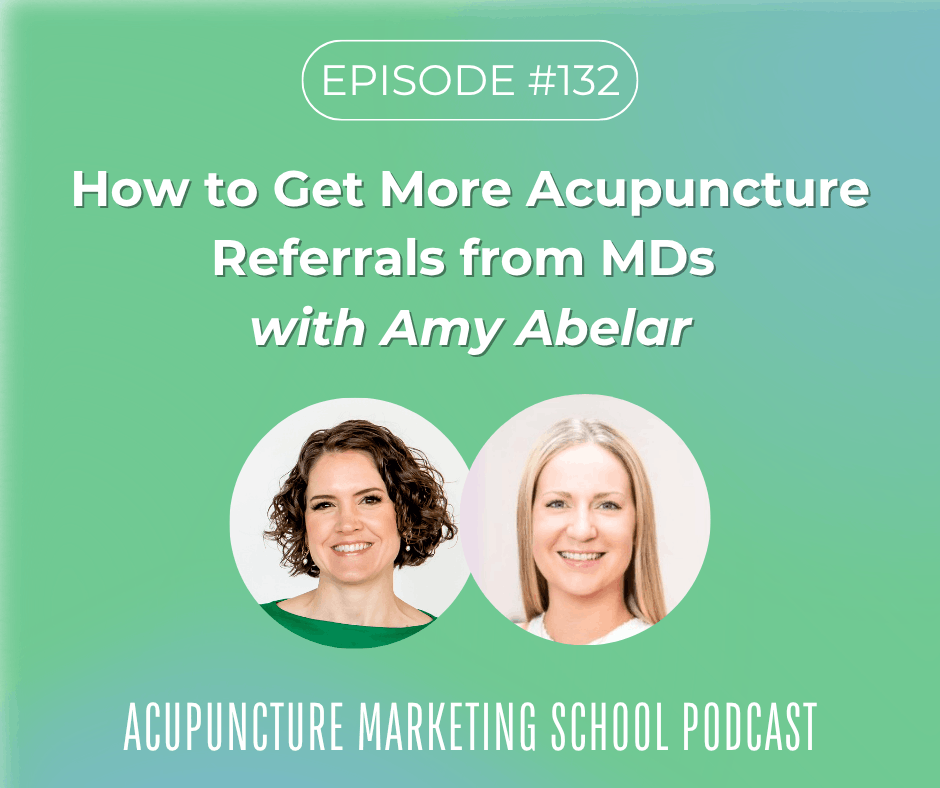
Welcome back! Today I’m joined again by Amy Abelar from Acupuncture Practice Systems for part two of her previous episode.
If you want to build stronger referral relationships with MDs and other healthcare providers, this episode is for you.
As we learned last episode, Amy has spent 18 years growing a thriving multi-provider practice. Today she shares practical strategies for creating referral partnerships that are genuine, mutually beneficial, and lead to long-term growth. And I think you’ll appreciate that she approaches these relationships from a place of service.
In this episode, we discuss:
- Why you must track where every new patient is coming from
- How to build referral relationships with OBGYNs, chiropractors, fertility clinics, and other healthcare providers
- The biggest mistake practitioners make when networking, and what to do instead
- Creative ways to get past the front desk and start meaningful conversations with busy medical offices
There are so many practical gems packed into this conversation with Amy. I hope it’s helpful!
Mentioned in this Episode:
- Acupuncture Practice Systems
- YouTube: @AcupuncturePracticeSystems
- Instagram: @AcupuncturePracticeSystems
- Acu-Hub.com: Virtual Reception and Virtual Assistant Services for Acupuncturists
- Marketing Breakthrough Audit with Michelle
🎙️ Listen to Episode 132: How to Get More Acupuncture Referrals from MDs and Other Healthcare Providers with Amy Abelar | Part 2
💛 Today’s Episode is Sponsored by AcuHub:
AcuHub provides remote reception and virtual assistant services specifically for acupuncture practices. I use AcuHub in my practice and I absolutely love it.
With AcuHub, you can rely on a dedicated US-based, highly trained receptionist to answer your incoming calls and inquiries, schedule appointments on your EHR software, onboard new patients, and answer questions specific to your practice.
Acu-Hub can also help with eligibility checks, billing, email and other assigned tasks that improve practice efficiency.
They offer month-to-month services with no contracts or termination fees, with rates between just $5-$8 per hour depending on your practice size.
Save time and money with your own dedicated Acuhub receptionist. Visit Acu-hub.com to learn more.
And of course, if you have questions about AcuHub, you’re always welcome to email me about my experience at michelle@michellegrasek.com.
💖 Love the podcast? Help other acupuncturists find the podcast by leaving a review.
Transcript:
Michelle Grasek:
Welcome to the Acupuncture Marketing School podcast. I’m your host, Michelle Grasek, and I’m here to help you get visible in your community, take marketing action with confidence, and get more patients in your practice and more money in your pocket every week. We both know you’re a talented, passionate acupuncturist and that acupuncture has the power to change lives.
So let’s dive right into this episode and talk about how you can reach more patients.
Welcome back. Today, I’m joined again by Amy Abelar from Acupuncture Practice Systems for part two of her previous episode.
If you’ve ever wondered how to build stronger referral relationships with other healthcare providers, this episode is for you. Amy has spent 18 years growing a thriving multi-provider practice, and she shares practical strategies for creating referral partnerships that are genuine, mutually beneficial, and lead to long-term growth. And I think you’ll really appreciate that she approaches these relationships from a place of service.
In today’s episode, we discuss why you must track where every new patient is coming from, how to build referral relationships with OBGYNs, chiropractors, fertility clinics, and other healthcare providers, the biggest mistake practitioners make when networking and what to do instead, and creative ways to get past the front desk and start meaningful conversations with busy medical offices.
There are so many practical gems packed into this conversation with Amy. Let’s dive in.
Today’s episode is sponsored by AcuHub. AcuHub provides remote reception and virtual assistant services specifically for acupuncture practices. I use AcuHub in my practice, and I absolutely love it.
With AcuHub, you can rely on a dedicated US-based, highly trained receptionist to answer your incoming calls and inquiries, schedule appointments on your EHR software, onboard new patients, and answer questions specific to your practice. AcuHub can also help with insurance eligibility checks, billing, email, and other assigned tasks that improve practice efficiency.
They offer month-to-month services with no contracts or termination fees, with rates between just $5 and $8 per hour depending on your practice size.
Save time and money with your own dedicated AcuHub receptionist. Visit acu-hub.com to learn more, and of course, I’ll put the link in the show notes for you. And if you have any questions about AcuHub, you are always welcome to email me about my experience with them at michelle at michellegrasek.com.
All right, let’s get into this episode with Amy.
Was there anything, any marketing that you recall doing as you were building, or maybe lately, that just didn’t work as well as you thought it would?
Amy Abelar:
Yes, so what I would say, there’s a lot of, how do I phrase this? There’s a lot of people. Social media has made it quote-unquote easy for us to boost our posts or create, you know, oh, you can create your own Facebook ad.
You can create your own Google ad. If you don’t know really well what you’re doing, it ends up being a waste of money. So you’re paying for the ad, but you’re not A/B testing it.
You’re not. I spent money on this before because I thought, oh yeah, that’ll work, and I’m guessing at what my target market is, or I’m guessing. It just doesn’t work, and you end up wasting money.
So if you’re going to do something like that, you want to make sure you’re going through someone who knows what to do. They know how to A/B test it. They are putting it in the appropriate categories. If you’re going to do it part way, do it all the way so that it has a great chance of being successful.
So I think a lot of times we’re throwing, have you heard the analogy of like if you throw spaghetti at the wall to see if it’s done, it’ll stick?
So I tried telling this to somebody one time and they were like, no clue what I was talking about. So I’m glad you get the reference.
One of the things that I will say is, to me, bottom line, most important with whatever you are trying is the mistake that a lot of people make is they will just, so if you’re making spaghetti and you take the noodle out and you throw it against the wall, and if it sticks, it means the pasta is done.
And if it doesn’t, it’s not done, right?
With marketing, if you’re just taking the noodle and you’re throwing it against the wall and you’re not paying attention, and you’re taking another noodle and throwing it against the wall and you’re not paying attention, pretty soon you have no more noodles left in your bowl. Some of it is overcooked. Some of it wasn’t cooked. Some of it was perfect. And you have no clue because you didn’t pay attention.
So one of the things I think is universal for everybody, no matter what, is whatever marketing efforts you are doing, you have to make sure that you can track it. Is it actually working for you? How do you know?
If you go to network, as an example, let’s say chiropractors might be great referral resources for you because you have a massage therapist in your office and you offer acupuncture and they do chiropractic and sometimes patients need more than just an adjustment, so you want to go network with them.
If you’ve done that, and let’s say you take like $15 off cards and you give them to each of the chiropractors you network with, if you start getting in these cards and your front desk person isn’t asking which provider they came from and you have no idea, you have no idea which relationship to nurture or not, right?
We started putting like a little stamp on the back of our $15 off cards, and then we have like a key for it.
So let’s say chiropractor A, we give a stack of $15 off cards that have a heart stamp on the back, and chiropractor B has a star stamp on the back. Well, if we have like five people that come in with these $15 off cards that all have a heart stamp on the back, you bet we’re reaching out to that chiropractor, thanking them for their referrals, wanting to really nurture that relationship and acknowledge the fact that they’ve referred.
But if you have no clue where these referrals are coming from, you don’t have the opportunity to thank someone, and they may think, oh wow, I sent all these people over there and they haven’t said anything to me, maybe they don’t continue.
Or now you’re thinking, oh well, it worked really well to network with chiropractors, but you networked with 10 of them and you’re only really getting cards from two. You know, drop the other eight, work with these two that have referred you, or reach out to those other eight who haven’t referred yet and see what else they might need to know about you in order to feel comfortable referring.
So again, all of it is data. If you don’t track it, you will have no clue what works and what doesn’t, and then you’re stuck just either feeling like nothing works when maybe there were a few things that really did that you could invest more time and money into, or you are getting lots of stuff, you know, lots of referrals back, but you’re thinking, oh my gosh, now I have to nurture all of these things that I put out there because I have no idea what worked and what didn’t.
I feel like that is the number one thing to make sure. Don’t put things out there without being able to track if they’re working for you.
Michelle Grasek:
So, so important. I am really curious if you have MDs who refer to you on a pretty consistent basis.
Amy Abelar:
I do have a few. One of the ladies that refers is a naturopath. I also have an OBGYN that refers.
These are people that I did really have to nurture that relationship with. They had a lot more questions because they, of course, come from a different background. And so I will say that the further apart you are on the spectrum of Eastern to Western, the more nurturing is required.
So birthing centers, as an example, birthing centers have been really easy for us to network with because these are women who are, they are there to give birth in a natural setting. They’re not giving birth in a hospital. They’re less Western medicine oriented.
They’re more natural oriented. And so networking in that environment and talking with birth centers is a much easier connection to get started than going into Western MD offices, for sure. There’s less of an uphill climb to find common ground, if that makes sense.
Michelle Grasek:
Sure. Yeah. What did that nurturing look like?
How did you even get in front of those doctors to begin with? This is a question people ask me all the time. I think it is just so challenging across the board to speak to a doctor, unless they are your doctor, because the receptionist is a gatekeeper.
They’re even opening the doctor’s mail.
Amy Abelar:
Totally.
Michelle Grasek:
So anything that they don’t think is important is not going to end up on the doctor’s desk. And you can’t just call and speak to the doctor, right?
Amy Abelar:
Yeah.
Michelle Grasek:
So it is super challenging to get in front of those people and to be able to speak to them long enough to build up a rapport where they’re like, okay, great. I’ll send you people.
Amy Abelar:
Totally. One of the things that I would say, number one thing would be to be on their website, on their profile, looking and gathering as much information about them as you possibly can. What is their specialty?
Who are they seeing? And how can you help their patients? You have to 100 percent approach it from how connecting with you benefits them and say nothing about how it benefits you.
Honestly, seriously, this is 100 percent how this works.
I have had the opposite happen with someone who was like, “Hey, we’re looking for a massage…”
This is when I was a massage therapist. It was somebody from a cryotherapy office.
And he reached out and he said, “Hey, we’re super interested in learning more about you. We want to have a massage therapist to refer to. We’ve got a lot of clients,” blah, blah, blah.
Totally pitched it as if he wanted to know more about me and send me clients. And I thought, oh heck yeah, I want to go meet this person.
I brought all my business cards. I brought all my everything. I sit down and I meet with him. The entire time, he’s telling me about cryotherapy. He’s telling me about their business. He’s pitching me everything about them.
And at the end, it was like, wait, what just happened? He talked about himself the entire time. And then I remember at the end, like a bad date.
Michelle Grasek:
Oh, 100 percent.
Amy Abelar:
I was like, this is a bait and switch.
He said, “So if you want to take these cryotherapy cards and place them in your office, we’d love to have you hand them out to all your clients,” blah, blah, blah.
I said, “Yeah, I could do that. Can I leave you some of my business cards to place?”
And he goes, “Oh, well, you know, we network with a lot of people. We really can’t have anyone. If we put your cards in, we’d have to put everyone’s cards in.”
Just totally rude.
Clearly I’m never referring anyone to you because it was a total bait and switch. So that obviously was not a good approach for him to use. He reached out initially sounding like that and then flipped it once I got there.
So absolutely reach out with how you can benefit the other provider’s patients. And then when you’re there, really just try to focus most of your conversation on that and how you’re going to be able to benefit.
Michelle Grasek:
Taking a quick break to remind you of today’s sponsor, AcuHub.
AcuHub provides remote reception and virtual assistant services specifically for acupuncture practices. I use them in my own practice and love having a dedicated receptionist to answer calls, schedule patients, and help with administrative tasks.
Services are month-to-month with no contracts, and rates are just $5 to $8 per hour. Visit acu-hub.com to learn more. And of course, I’ll put the link in the show notes for you.
All right, let’s get back into this episode with Amy.
Amy Abelar:
Let’s say for an OBGYN, one of the things that’s really helpful is you will have those. I feel are honestly pretty darn easy, even though they’re Western medicine, because patients who are pregnant, if you are working on pregnant patients or fertility patients, patients who are pregnant, they cannot take Western medications. There’s a lot of Western medications they can’t take.
They can’t take pain meds. A lot of them, they won’t even take allergy medication. They won’t take certain medications for constipation, right?
There’s so many things that we can help with from a very holistic perspective when patients are pregnant that a lot of Western medicine options are just not available to those patients.
So those are great patients where that doctor might be very Western, but their patients have to be more holistic during that timeframe.
Or you may have people where they’ll say, hey, if you have patients who are giving pushback that are not interested in birth control, but they have horrible periods, here’s some studies for where acupuncture has been successful at helping these kinds of patients manage their pain.
So you’re offering it as a way to support their patients who either can’t utilize Western medicine for certain things and acupuncture can step in, or you’re taking it from the approach of, you know that they are going to have patients who are not interested in whatever the Western option is that they’re being presented.
And so studies are super helpful. If you can look up studies and present those studies, that’s really helpful.
Drug reps go in all the time and bring lunch to staff to pitch. So you, yeah, you can absolutely do that. It’ll cost you a little bit of money because you’re going to have to buy the lunch or the coffee or whatever the case may be.
But now you have an audience with these providers, and you know, that’s a business expense that goes on your business credit card or out of your business bank account when you’re paying for those kinds of things.
That I found has been really helpful.
There’s a local fertility center here who is very hard to get in with. They have very few acupuncturists listed on their list of providers who can come on site and do acupuncture for pre-post-transfer treatments. That list is full. It’s been full for years.
They don’t take anybody new. The woman who is in charge of gatekeeping for that is known for being very unapproachable.
And so I reached out as a, “Hey, we have had a lot of patients who have been asking us which fertility center we recommend. We specialize in infertility, so we’ve got a lot of patients who are trying naturally, but they may not be able to conceive naturally. And they’ve asked us which clinics we recommend. How would I get more information about your clinic so that I would be able to know whether or not I’d be able to recommend your clinic?”
And she said, “Actually, you can come in and I’d be happy to give you a tour of the office.”
And I said, “Can I bring you a coffee? What kind of coffee would you like? Let me bring you something. I really appreciate the opportunity.”
And so I brought her and another coworker their coffee that they specifically requested. She spent like an hour and a half with me. She talked about the practice.
I found common ground on the ways that we are super ethical and how we treat our patients and how I really appreciate their approach. And she showed me the clinic. She showed me a whole bunch of places within the clinic and introduced me to a few other staff there.
And at the end of it, she ended up adding me to her list.
But I didn’t start out saying, “Hey, I would like to get added to the list. Hey, I would like for you to refer people to us.”
I started out by asking, “I would like to know more information because patients ask us, and I want to know how to best answer their questions and see if you might be a center that we would refer to.”
And that was how I started my approach. And it wasn’t until the very end of the hour-and-a-half thing.
All I said was, “I know that you guys have a really short list and you don’t add anybody new. If at some point someone falls off, I’d love to be considered to be added on.”
And she’s like, “Oh, I can totally add you.”
And now I’m second on there under her favorite, favorite person.
And so, I mean, you just, you have to approach it. And that’s not going to work for everybody, right? That’s not going to work all the time. It works some of the time, but the more you put yourself out there, the more opportunities you have for it to work out.
Michelle Grasek:
Yeah. And I really appreciate that you were willing to invest that time with them regardless of whether your name ended up on the list.
Amy Abelar:
Totally.
Michelle Grasek:
It is like an investment, right? Of course, ultimately you want to be on the list and this is one route to do that, but you’re still committed and, you know, you’re representing your business whether she decides to put you on there or not.
Amy Abelar:
Absolutely. Well, and the nice thing is, what’s my consolation prize? If I don’t end up getting on the list, my consolation prize is at least I’m still benefiting my patients.
I do have fertility patients. They will ask me those questions. And so I do still have information now where I can feel more confidently referring them to that clinic.
If that ends up being what that patient needs, or if you have patients who are already going through IVF and they say, “What have you heard about this space?” I can give my feedback about it in an honest way because I’ve been there. I’ve met them.
I’ve seen the clinic. I’ve met the staff, that kind of a thing. So either way, it benefits my practice because it benefits my patients.
Michelle Grasek:
So true.
So for those lunch and learns that you did, you called the front desk and sort of pitched them the idea, very similar to how a pharmaceutical rep would do it.
So, “I’m a local acupuncturist. I’d like to bring you lunch for you and your staff and talk about this specific topic, acupuncture for XYZ,” and then just see if they’re open to it.
Amy Abelar:
Yeah. So I have done it a number of ways that all work roughly about the same, the same consistency. Different styles work with different providers.
So that’s the challenge.
Let’s say I had a patient who was seeing their primary care and their primary care wasn’t really addressing whatever was going on with them.
So I’ll give you an example. And this is actually, it’s not primary care, but I have a patient who is going through cancer treatments and she has neuropathy in the feet that is as a result of chemotherapy.
And her doctor told her, “You’re just SOL. There’s nothing you can do about it. And because it’s due to the chemo, it’s never going to come back. And this is just something you’re going to deal with the rest of your life.”
She’s been coming in, getting acupuncture, and she’s gotten a lot of relief.
And she has been so thankful for the fact that she did try acupuncture, and she was referred by another friend of hers who is a patient of mine who also got relief from something they were not expecting to get relief from.
And so sometimes that in itself is a category, right? “Hey, acupuncture helped me with this thing that I didn’t even think was possible. Maybe it’ll help you with the thing that you were told was not possible.”
I asked her if she was open to telling her doctor about the fact that she tried acupuncture and that it’s been helpful and where she’s been going, so that if they have other patients who end up having a similar issue, they can say, “Well, some of my patients have done acupuncture and it’s been really helpful for them.”
So kind of like a back up the food chain thing.
So I’ve taken that approach. I’ve also done the approach where I have a patient who’s gotten relief, and I’ve then sent their doctor a message with the patient’s permission.
“Hey, we’ve been working on this and that. This is what the results have been. I just wanted to pass that along in case you have other patients who are interested.”
I have done sending letters. I’ve done sending emails. If you send a letter or you send an email, you have to follow up with either in person or a phone call. Anybody can send a letter.
And like you said, most of the time, those get ripped up. It goes back to the whole touch points thing we talked about earlier, where even if the front desk has opened your letter up, looked at it, said, “I don’t think so,” shredded it or ripped it up or threw it in the trash, whatever, at least then when you call back a week later, you’re fresh in their mind of, oh, this is the second approach that this person already sent something to me.
So you at least have that little bit of recognition, or you go in person and you talk to them about it.
And I’ve really pitched it as, “Hey, I’ve had a lot of patients who have been coming in for…”
Let’s say it’s the OBGYN office, just for simplicity of examples.
I can say, “I have a lot of prenatal patients who are coming in that are really looking for holistic ways to manage their fatigue and their morning sickness. And since a lot of Western medications are contraindicated during pregnancy, I just wanted to see if I could drop off some flyers that just talk about acupuncture being a holistic approach to some of these things. If that’s okay for me to leave in your office, or if maybe your doctor’s interested in me coming by with lunch sometime, I’d love to talk to them more about how acupuncture can support their patients holistically through that time period, that these patients don’t have a lot of other options.”
And then that way it very much is, I want to help support your patients. These are other patients that I have.
And then always come prepared with studies when you talk to the doctors because Western medicine providers often are really wanting that.
Michelle Grasek:
Which is understandable, right? I mean, they have a lot of responsibility to only recommend the things that they feel are safe.
Amy Abelar:
Yeah, absolutely.
Michelle Grasek:
So I have one last question for you that I ask all of my guests, and that is, what is your definition of success?
Amy Abelar:
Success has changed a lot for me throughout my career, what it looks like.
Initially success was, I want to have a big clinic with lots of patients. Success in terms of magnification of the business.
And over time, I’ve definitely changed my perception, where really success to me is having a business that supports the life that I want to have.
Success is me being able to be present with my patients when I’m treating patients, but also be present with my family when I’m home. So the business that I have built and the systems that I’ve put in place have freed me up to be able to do the things that I want to do and that I enjoy doing both inside and outside of my practice.
So I’ve grown a successful business that we’ve grossed regularly for a long time now over a million a year. We’re getting real close to that 2 million mark.
Michelle Grasek:
Amazing.
Amy Abelar:
A long time ago, that was my thing. Oh, I want to make so much money and I want to be, you know, that’s gross, not net.
But for me now, it’s like, wow, but I have created 24 jobs.
It’s not just about how much money, right? Because obviously that’s gross, not net. But with having grown that business, I have created 24 jobs for other people.
I have a team of front desk staff and an office manager that can keep things going and run the systems that I’ve built, and we constantly are refining those systems so that when I am at home with my family, they’re handling things. They’re not reaching out to me.
And when I’m treating patients, I can just wear my acupuncturist hat and be treating my patients.
So really, again, success is different at different phases of your life.
For me now, it’s really about that I’ve been able to grow a practice that supports my life and gives me the freedom and the freedom of time and money to be able to live the kind of life that I want, and not be in this state of, I have to treat this many patients this week or I’m not going to pay my bills kind of a thing.
You’re able to give, I feel like, differently to your patients when the money piece of it is covered.
Michelle Grasek:
For sure.
Thank you again so much for being here and sharing all of this with us. Where can everyone find you online? Where can they reach you? Yeah, tell us everything. How can we find you?
Amy Abelar:
Yeah, absolutely.
So my biggest thing right now that I’m offering is the Acupuncture Practice Systems membership. So the website’s just acupuncturepracticesystems.com.
We do have Instagram and Facebook, and I have a YouTube channel where I do a bunch of videos just giving people helpful practice management tips or things to consider that they might not have considered that are hurdles for practice management.
And the membership is basically just this library of resources that I have created over the last 18 years, whether you’re just starting out or you’re trying to grow your practice or you’re looking to hire admin or other providers or rent out extra rooms or whatever the case may be.
It’s just a library of resources that people can have access to depending on where they’re at in their practice to help them succeed.
Michelle Grasek:
Amazing. And we will put the links in the show notes so everyone can find them very easily.
Thank you again so much for being here. We will definitely have to do this again. I have more questions.
Amy Abelar:
Absolutely. I’m happy to answer whatever questions you have.
Michelle Grasek:
As always, thanks so much for listening.
If your marketing is feeling stuck, I’d love to help you figure out exactly what to focus on next. The Marketing Breakthrough Audit is a personalized 30-minute video review of your website, your Google Business Profile, and other parts of your online presence with clear, practical recommendations tailored to your practice.
No generic advice, just the changes I would prioritize if this were my own clinic.
You can learn more and reserve your spot at michellegrasek.com/audit.
Thanks so much for being here. I’ll talk to you next time.