
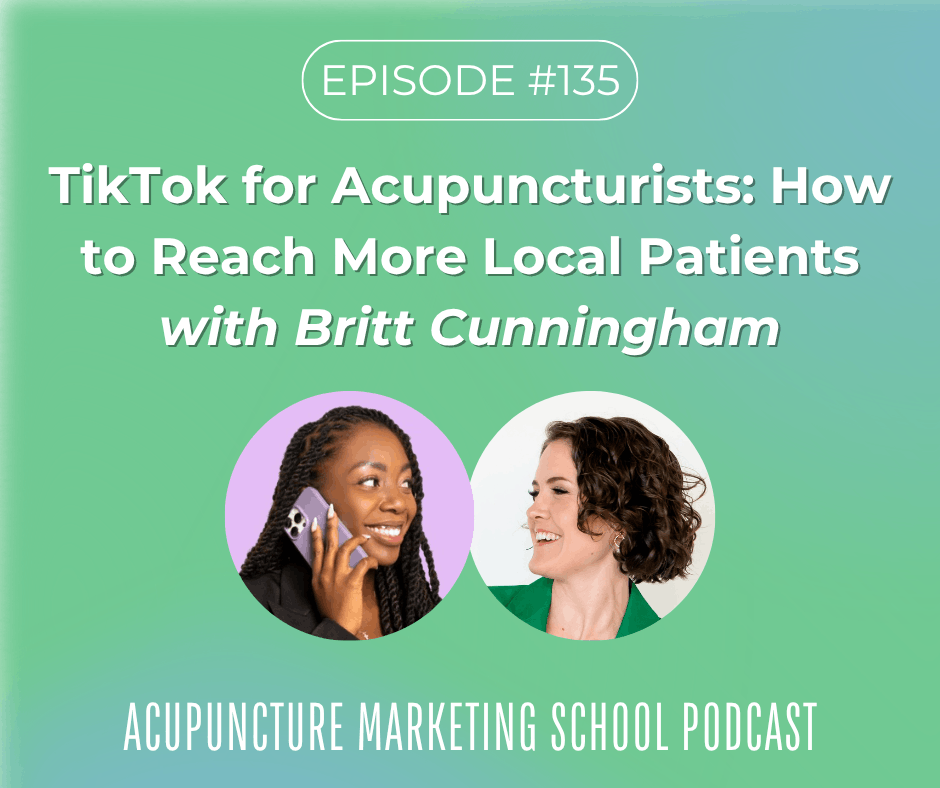
Today I’m talking with Britt Cunningham, founder of Brit Social Media, about whether TikTok actually is worth your time as a local, brick-and-mortar business.
Britt works with service-based businesses, including acupuncturists and other wellness entrepreneurs, to manage their social media strategy and content.
The last time she was on the podcast, we talked mostly about Instagram, but she mentioned that TikTok has some unique advantages when it comes to reaching a local audience. That caught my attention, and since then, I’ve actually started experimenting with TikTok for my own acupuncture practice.
In this episode, we talk about:
- Why TikTok may be better than Instagram in terms of getting your content in front of people who actually live near your practice
- How to repurpose the Reels you’re already creating for Instagram, instead of making new content
- What to post, how often to post, and what kinds of content are working well for acupuncturists and wellness practices right now
- How to start showing up on video when you’re uncomfortable on camera, including an easy way to begin with B-roll
We also talk about why you probably don’t need to spend nearly as much time writing TikTok captions as you do Instagram captions, which I personally consider excellent news.
Hope you enjoy this episode with Britt!
Show Notes:
- Britt’s Website: Britt Social Media
- Instagram @brittsocialmedia
- TikTok @brittsocialmedia
- YouTube @brittsocialmedia
- Michelle’s Marketing Breakthrough Audit
🎙️ Listen to Episode #135: TikTok for Acupuncturists: How to Reach More Local Patients with Britt Cunningham
🩵 Today’s episode is brought to you by Jane, an EMR for health and wellness professionals, and the software I use at my practice. 🩵
One of my favorite things about Jane is their genuinely excellent customer support. If you have a question, you can call, email, or live chat with a real person, even on Saturdays, at no extra cost. And I can tell you from experience, their support team is incredibly kind, patient, and actually happy to help.
If you’re ready to learn more and get a free demo, head to jane.app/explore, and use my code ACUSCHOOL1MO for a one-month grace period on your new account.
💖 Love the podcast? Help other acupuncturists find the podcast by leaving a review.
Michelle’s Free Ten-Minute Marketing Guide for Wellness Professionals: Exactly how I’d market my practice if I only had ten minute a week – Download Here
Transcript:
Michelle Grasek:
Welcome back! Today I’m talking with returning guest Britt, founder of Brit Social Media, about something I know is on a lot of acupuncturists’ minds: Is TikTok actually worth your time as a local, brick-and-mortar business?
Britt works with service-based businesses, including acupuncture and wellness practices, to manage their social media strategy and content. The last time she was on the podcast, we talked mostly about Instagram, but she mentioned that TikTok has some unique advantages when it comes to reaching a local audience. That caught my attention, and since then, I’ve actually started experimenting with TikTok for my own acupuncture practice.
In this episode, we talk about why TikTok may have an advantage over Instagram when it comes to getting your content in front of people who actually live near your practice.
How to repurpose the Reels you’re already creating for TikTok and YouTube Shorts, instead of constantly making new content.
What Britt recommends posting, how often to post, and what kinds of content are working well for acupuncture and wellness practices right now.
And how to start showing up on video when you’re uncomfortable on camera, including an easy way to begin with B-roll.
We also talk about why you probably don’t need to spend nearly as much time writing TikTok captions as you do Instagram captions, which I personally consider excellent news.
Let’s get into it.
Today’s episode is brought to you by Jane, a practice management software and EMR that comes with something that can be hard to find: support that feels supportive.
When you’re choosing the right software for your practice, it’s worth thinking about what support actually looks like: what happens when something goes wrong, or when you’re just trying to figure a workflow out? With Jane, you call them. Or email. Or chat. And a real person picks up, even on Saturdays, at no extra cost.
For a lot of practitioners, that makes a big difference.
Jane also has a growing library of guides and tips to help you learn at your own pace, as well as onboarding and import support, so switching is simple and not stressful.
When I first signed up for Jane I was initially worried about how often I wanted to call or live chat with them for help. I don’t know if you’ve ever talked to a support person who was not happy to be helping you, or seemed tired of your questions? That’s kind of what I was afraid of – that I was being too much, or asking for help too often. That is not how Jane operates at all. These support people are genuinely cheerful and interested in hearing your questions and getting things sorted out for you. They will even send screenshots or a video screenshare with arrows explaining step by step how to do somethin, if you need it. I went to a Jane Ambassador conference a few years ago and learned that when Jane is hiring, they are looking for people who are two things: smart, and kind. They said they can teach everything else – how to use the software, etc. But smart and kind they cannot teach, and value a ton. And this definitely comes through in their support team. I am not joking about their cheerfulness, either. Jane’s tech support is the best.
Head to jane.app/explore to learn more. And when you’re ready, use my code ACUSCHOOL1MO for a one-month grace period on your new account. The link and the code are in the show notes for you.
Okay, let’s dive in with Britt today!
Hi, Britt. Thank you so much for being here. How are you?
Britt Cunningham:
I’m doing really good. I’m happy to be back to talk about social media. Yeah, I’m doing pretty good.
Thank you for having me.
Michelle Grasek:
Absolutely. Last time we talked, it was mostly about Instagram, and you had tossed in towards the end of the conversation how TikTok was typically better for local brick and mortar businesses because it has some features that make it better for local people to find us. So I would love to talk about all things TikTok today.
Britt Cunningham:
Yeah, absolutely. TikTok has performed really well for my brick and mortar clients. I do have acupuncture clients and people in the health and wellness space that have physical locations.
And Instagram is definitely still king when it comes to social media as a whole, but a lot of people are on TikTok. And I really implore people, business owners, to get on TikTok because they have certain features that will push out their content better than Instagram. So for example, on TikTok, there is a page or a feed that’s called local, and that feed just shows everything that’s local to you.
So I’m in South Florida in Fort Lauderdale, so it will show me farmers markets that are going on. It’ll show me local businesses. It’ll show me basically anything in my area.
So if you are a business owner and you’re trying to reach more people, that is going to be a godsend because it’s free and the algorithm is purposely pushing local people. So that’s one of the really good tools that it has. Also the algorithm, the SEO, if you are scrolling and you’re interested in certain things in your area, eventually you will pop up.
So that’s kind of a little bit about the TikTok algorithm and just why I think it’s great for business owners.
Michelle Grasek:
The way that I understand Instagram’s algorithm is that it’s more interest-based. Is that right? And less about your actual location.
Britt Cunningham:
Yeah. So it’s definitely more interest-based. You’ll see content from anywhere around the world really.
I know for my boyfriend, for example, he’s super into music. So all he sees on his feed is music, artists, things like that. But my sister, for example, she’s super into cooking.
So that’s all she’s going to see. They’re not necessarily showing you the local business down the street or anything like that, unless you are interested in things like that. So for me, I’m someone who likes to get out of the house and go to local events.
So I do see stuff like that often because I’m actively searching for it. But if you aren’t actively searching for it, Instagram doesn’t really provide that to you. Unlike TikTok, TikTok does show you that regardless of if you’re interested in or not.
Michelle Grasek:
So after we had talked about this the first time, I went ahead and set up a TikTok account after maybe seven years of avoiding it because it just made so much sense to me. And we are very niche. We do cosmetic acupuncture and microneedling in addition to just regular acupuncture.
And sometimes cosmetic acupuncture is a tough sell. But I find that when people see our videos on Instagram, they understand, wow, this is not scary. It’s much more relaxing.
I get a face massage. And it just made so much sense to me to put those videos on TikTok to push to a local audience. So my question for you is, if we have a body of Instagram reels, can we put those on TikTok if we just start a new TikTok account, at least as a way to get started?
Britt Cunningham:
Yeah, that’s actually what I recommend people do is you don’t have to necessarily reinvent the wheel or come up with a new strategy or new videos. You can just repurpose your content onto TikTok. And you’re going to see that certain videos take off more than others.
But the fact that you are putting the content there is just going to give you a little bit more visibility, especially to more local audiences. So absolutely, I would implore anyone to repurpose your content on all of the social media platforms, whether it’s TikTok, YouTube Shorts, Facebook, literally everywhere that it’s just going to give you more visibility.
Michelle Grasek:
I really like that idea of putting those short form videos on YouTube Shorts. And I can’t even remember if I ever set up a YouTube channel for the clinic. I may have, I guess I have not thought about it in a long time.
Now, is YouTube also searchable in a local way? Or that is more based on literally what someone’s putting into the search bar?
Britt Cunningham:
Yeah, so people, it depends on your preferences as a user. Most people are similar to Instagram, just looking up their interests or how to do something. But some people are looking up local things that are happening or just things that are happening in there in the news.
So it’s, I wouldn’t use YouTube Shorts necessarily for the local audience that you’re trying to build. But if you have maybe a course, or maybe you have something that you’re trying to promote that anyone can kind of utilize, YouTube is a great place for that. That’s what I would use it for.
Michelle Grasek:
Okay. And I have seen plenty of acupuncturists growing their clinic YouTube channels, and they seem to be mostly educational. But I also would imagine that has to really improve their authority with people who are local and run across their channel.
Maybe it’s not how they discover them, but helping them realize, wow, this person really knows what they’re talking about.
Britt Cunningham:
Yeah, for sure. It’s a great authority builder. And same thing with Instagram as well.
It’s really good for people to be nurtured by your content. If they do find out about you, they do tend to search you up on social media. So if you have a presence, that’s just really good for them to also continue down the process of trusting you and your clinic.
Michelle Grasek:
It gives them something bingeable, right?
Britt Cunningham:
Yeah, exactly.
Michelle Grasek:
So I think I’ve been repurposing my Instagram Reels on TikTok for two months now. I have everything set up in later and it just goes out. And I am not engaging on there like I know that I should, because it’s social, right?
So that requires that you engage with potential followers or maybe other small businesses. And I haven’t really been doing that, but our follower count is growing by itself. We’re not at anything major.
I think we have 56 followers. But for two months of mostly ignoring it and letting it be automated, I’m impressed. And I have noticed that people ask questions in the comments about what we’re doing, which I haven’t really had on Instagram in a very long time.
So we had a video about acupuncture for plantar fasciitis, and the needles are so thin you can’t really see what she’s doing. So someone had commented, what is this treatment for plantar fasciitis? And then someone else had asked a question about cosmetic acupuncture because of the video.
So it’s nice to see, wow, these are real people. Hopefully local, no guarantee, but things are happening even though my input has been minimal. Because I know that’s one thing that people tell me is they’re afraid to commit to another social media platform.
But I just am feeling like with the local signals, TikTok is really turning out to be worth it.
Britt Cunningham:
Yeah, for sure. I’ve also seen a boosted engagement on TikTok over Instagram, specifically for clinics and brick and mortar businesses. On TikTok, the energy and the vibe there is just so different.
People are a lot more social versus Instagram. People are more professional. They’re more careful about the things that they comment, things like that.
But TikTok, it’s kind of like we’re just all having a good time over there. So they’ll ask more questions. They’ll be more in tune to comment certain things on there.
So that’s another reason why I really do love TikTok for businesses. For example, one of my clients, she gets questions all the time, where are you located? What exactly does this do?
She’s getting those questions a lot more on TikTok than Instagram, even though it’s the same exact content. So I think there is a lot to be said about just the difference with the users on each platform.
Michelle Grasek:
So interesting. Yeah. I remember the first time I logged into TikTok, I was so overwhelmed.
I was like, who are all these beautiful people? What is happening? And I think it is a little more fast-paced than Instagram as well.
The videos are shorter and snappier.
Britt Cunningham:
Yeah, for sure.
Michelle Grasek:
I did notice that in the beginning, what I was doing is I was also just copying and pasting my Instagram captions and realized that they’re super long compared to the acupuncturists that I was following because I’m observing. I was like, wow, she’s saying three sentences and then a couple of hashtags. And sometimes she doesn’t even have a call to action.
And I know this woman knows how to use TikTok, so I’m doing something wrong. So I did some research and now I’ve really shortened up my captions because I just didn’t get the impression that anybody is even really reading the captions in TikTok. They’ve got to be brief.
Britt Cunningham:
Yeah. So that is one of the major differences between the two platforms. TikTok captions are as nearly as important as Instagram.
It’s good to have something for just that SEO and that searchability, but you don’t necessarily, on Instagram, a lot of people will post almost like a blog in their captions. It would be super long and in depth or telling a story. They have a lot of hashtags.
TikTok doesn’t really need all of that. You can just simply say one or two sentences for your caption. Even the hashtags aren’t necessary.
Call to actions aren’t necessary. I think it has something to do with just the visual look of the TikTok captions versus Instagram. It’s on usually a clearer background.
People just jump straight to the comments. They don’t even read the caption half the time. So I think it’s just has to do with the user kind of skipping it.
So I wouldn’t put any energy into the captions. I would put the energy into the actual video that you’re posting, the content that you’re posting and making sure that the call to action is in the content itself. So verbally saying the call to action at the end of the video or even in the middle and then leaving the captions for just SEO purposes.
Michelle Grasek:
Gotcha. Okay. That’s really good to know that a lot of the users are just kind of skipping it and going straight to the comments.
Yeah. So I was going to say, sometimes the comments are wild, really entertaining.
Britt Cunningham:
Yeah. The comments on TikTok are super fun and lively. Like I said, people actually want to communicate and be social on TikTok.
Michelle Grasek:
So you said that you recommend verbally saying the call to action in the video. Do you also recommend putting it as text on top of the video?
Britt Cunningham:
Yeah. So text, verbal, it’s the same thing with the hooks that you’re using too. You want to hook people in as much as possible.
You want to get them to take an action. So I do verbal call to actions. I might just point up and say, okay, follow me for more or something like that.
It doesn’t have to be complicated.
Michelle Grasek:
And what is your social handle so people can follow you? Yeah.
Britt Cunningham:
So it’s social media on all platforms. Okay.
Michelle Grasek:
Brits social media. Got it. And I’ll put that link in the show notes as well.
But for anyone who’s on their phone right now, you can go right there. So, I mean, I think that also makes TikTok a little easier in some ways, if you don’t have to think too hard about the caption, because both the video piece and the caption piece can be a lot of work on Instagram. People are really, they’re writing an essay.
They’re really refining it in their Instagram caption. So it’s one less piece of work to do on TikTok. Exactly.
Britt Cunningham:
Yeah. It’s one less thing to do. And I also think that with Instagram, it’s people care more about these little things, but on TikTok, because it is so fast paced to your point earlier, people don’t care as much.
So that takes the stress away from it a little bit more, I think.
Michelle Grasek:
Yeah. I feel like I have noticed that some creators are producing so much content that perfectionism just is not necessary.
Britt Cunningham:
Out the window.
Michelle Grasek:
Yes. They’re like, oh, I had a typo or I said something I didn’t mean to say, but tomorrow will probably be better.
Britt Cunningham:
Yeah, exactly.
Michelle Grasek:
Is there an amount of content that you recommend for brick and mortar local businesses?
Britt Cunningham:
I would say, and this can be for Instagram or TikTok, but I would say minimally you should be posting three times a week. If you can do more than that, please do that. If you can do five times or even every day, that would be great.
But I would say the sweet spot is between three to five times a week, minimal. And the reason why is I really believe that quality matters more than quantity. You don’t want to just be posting random stuff because it’s not going to go anywhere.
You want to have a strategy behind all your posts. You want to make sure your posts have a goal. So some posts are for education.
Some posts are for selling. Some posts are for announcements. Every post should have a goal.
It shouldn’t just be random unless you’re also trying to build a personal brand. If you’re trying to build a personal brand, that’s a different strategy. But for businesses, it doesn’t need to be super complicated.
I always say have something educational so that you’re attracting new people. Have something where you’re tackling objections. So a common objection for acupuncture is it’s super simple.
People are afraid of needles. So making content around that, the different things that make your clinic stand out and makes it unique, that’s the kind of content I would regularly post. And then everything else is just fun extras, whether it’s trends that you do in your clinic with your team members or maybe telling the story of how you built your business, things like that.
Those are just fun extras.
Michelle Grasek:
I love the behind the scenes of how you built your business. I think that is something that the audience really loves but that we don’t think about. I don’t know if you have experienced this also.
I feel like small business owners don’t take time to celebrate their milestones and they’re on to the next thing. There’s always something else to hustle towards and they really forget, wow, this has been such a journey and so many hurdles. And sharing that with people, it almost binds them to you.
They feel like they’re part of your journey.
Britt Cunningham:
Yeah, for sure. I remind my clients all the time that every month or every couple of months, we do a reintroduction post. So for the new people that are following you, they don’t know about all your milestones.
They don’t know much about you besides if unless they went back and scrolled your previous content. So it’s good to have fresh content explaining your journey, showing a little bit of your personality, how you started. That kind of content usually does perform well and it connects with people because again, people just want to connect with you.
So that’s something to do regularly.
Michelle Grasek:
What would you tell the people who are either afraid to get on video or just afraid to share their face?
Britt Cunningham:
So this is common with business owners. You become a business owner to run the business and not become a content creator. But with the way that things are with marketing now in 2026 and beyond, people really love to connect with people.
That is something that’s super important and it doesn’t necessarily have to just be you. If you have people on staff that are willing to make content, include them in the content as well and show many faces. It doesn’t just have to rely on you as the business owner.
But the more you show your face, the more you show up. People again connect with you and your business and it makes you stand out from others. And also you can start small.
It can be some b-roll clips. B-roll is the easiest type of content to make. You’re just filming yourself in your office or working or doing whatever and you use that as the visual for your content and that removes a lot of the anxieties around filming and reading a script and having a hook and all these things that we tell you to do.
It removes all of that because you’re just starting small with b-roll. So that’s something that I always tell people to do in the beginning if they have some fears around filming. And then secondly, I would also just say it’s a skill just like learning an instrument or a language.
It takes time to get comfortable in front of the camera. It takes time to get comfortable with showing up and being present and being forward-facing. So take time.
Give yourself grace with that. You never know. Within a few months, you might love it.
So give it a try. And yeah, that’s what I would say.
Michelle Grasek:
Yeah, I like that it doesn’t have to be the talking head from the get-go. I think that’s what people are imagining. I have to memorize the script.
I have to deliver it like a newscaster with no flaws as if it were live. And I see this so consistently with all my marketing clients that when they share their face on social, those are the posts that get the most likes and engagements. And just their regular patients or followers, they’re in the comments, oh, hi.
I literally saw you last week, but hi. How could that be a bad thing? They’re genuinely so happy to see you in their feed.
Britt Cunningham:
Yeah, exactly. They want to connect with you. And that is the biggest thing that’s going to sell your business and your services because other businesses, they have faceless accounts and things like that, but you never know how else they’re marketing or how else they’re showing up.
Maybe they are showing up in person more. I would just say, give it a try and be consistent with it. Start small and see how it goes.
Michelle Grasek:
And you run social media accounts for many different kinds of business owners, including acupuncturists, like you said, and other health and wellness people. Is there any other kind of content that you think is working really well for acupuncturists lately?
Britt Cunningham:
I would always go back to handling objections that people have. If people are new to acupuncture, they don’t understand the science behind it. They don’t understand certain things.
Educating them is always a good reoccurring thing to do in your content because you’re in that world. So you already know the things, but a lot of people don’t. So it’s a good way to bring new people in by just educating them on the basics.
It doesn’t have to be complicated, just on the basics of it. So that’s something that I would definitely recommend people doing. It’s just educational content.
And then also the lighthearted, fun things too is good. Making content with your team, day in the life stuff. It doesn’t have to be complicated.
Just simple stuff of what you do as an acupuncturist on a regular basis, why you started it, why you got into it. Stuff like that is a reoccurring content that you can make.
Michelle Grasek:
I once created a open the office with me video and I was like, why would anybody want to see me turn the lights on at my clinic? It’s probably one of the most popular Instagram reels that I’ve published and I published it twice a year apart. It did really well.
Let’s see if people want to see me turn the lights on again.
Britt Cunningham:
It’s funny because it’s your everyday life, but a lot of people it’s new. It’s exciting to see what does this actually look like for you? And I also love that you saw that it worked and you did it again.
I do that all the time. If something works, do it again and again and again, make tricks to it.
Michelle Grasek:
I am so happy to hear you say that because I think that is really hard for some of my marketing clients and the audience in general to just to republish the same exact post. A year later, they’re often really afraid people are going to remember this or to send an email newsletter that did well last year to send it again this year. They’re like, people are going to recognize it.
And I just think that maybe a couple of people recognize it, but the vast majority of people, I mean, they’re not, I hate to say they’re not paying that much attention. They’re skimming, right? They’re not necessarily going to say you definitely sent this identical email about osteoarthritis of the knee.
And you sent this exact same research article a year and a half ago and said, they’re probably going to say, oh, right. Wasn’t I going to forward that to someone? I was going to send this to my grandma and I never did.
Britt Cunningham:
Exactly. Yeah. People aren’t going to remember every little thing that you do and not everyone will see it as well.
So maybe the video you posted, it only got 500 views. Maybe if you repost it again, it’ll get more views from different people. That’s one of the benefits of using a feature like trial reels, where it goes to completely new people.
So I’m a big person when it comes to repurposing your content. I have a particular few videos on my page that I’ve repurposed every single month because it always performs well. I do this with my clients too.
If I notice that a certain type of video we do does well, every month, we try to incorporate that into the content cycle.
Michelle Grasek:
Yeah.
Britt Cunningham:
And we’ll try to change it up a little bit. Sometimes we’ll change maybe the background music or the intro, the first five seconds, maybe we’ll use a different hook or something like that, but it’s essentially the same content and it helps because it grows the page. It shows it to new people, especially if you’re using things like trial reels for that.
Don’t be afraid to reuse content over and over again, especially if it’s doing well.
Michelle Grasek:
Are there any mistakes that you see either acupuncturists or just health and wellness business owners making on TikTok or things to avoid?
Britt Cunningham:
Yeah. So I just posted about this, but this is something that I’ve been seeing happening maybe recently, more recently, maybe over the last six months or so, four to six months is a lot of people are using AI for their content. And sometimes it’s not bad.
It’s tolerable, but majority of the time, I would say 80% of the time, it doesn’t look as good. There’s a lot, especially with flyers and things like that, there’s a lot of text, there’s a lot of elements, there’s a lot of random colors, and it is really overwhelming. And I know that a lot of people are using AI to save time, maybe save money, but I think it’s doing more harm than good when it comes to marketing.
Maybe hire someone who knows how to use AI and maybe can teach you how to use it to make it look a lot better. But that is something that I’m seeing happening a lot. And I don’t think it’s getting any better, unfortunately.
The flyers just look really crazy.
Michelle Grasek:
Can we talk about the flyers for a second? I had a marketing client who was so thrilled to have some flyers produced by AI. And I took one look at it and it had information and text and icons and little lines and squiggles on every available inch, plus an image in the background.
And it was really overwhelming, like you mentioned. And I mean, if you think about someone who’s trained in graphic design, you’re probably trained in graphic design, I would imagine, and also videography. There’s a specific amount of text, and it’s supposed to draw the eye from one thing to the next.
There needs to be a hierarchy, I guess is what I’m trying to say, so that your brain doesn’t explode. And he was like, I think it’s very polished. I’m like, it is.
I think that’s what’s trapping people, is it is a polished amount of text that makes it look like your graphic designer was on cocaine when they made it. Yes, and I can identify a flyer that’s made by AI in an instant. And I think it’s getting to the point where even people who are not in marketing can also identify.
And I think for the most part, our audience is a bit forgiving, because we’re small business owners. So if we want to create a flyer for AcuYoga and use AI, maybe they recognize it, they’re like, okay, I get it. That’s certainly different than, I think, AI-generated images or video.
I mean, I can’t even think of an acupuncturist who has used AI-generated video for their social.
Britt Cunningham:
It’s happening.
Michelle Grasek:
It’s very obvious and painful.
Britt Cunningham:
Yeah, it’s very obvious, I think, to most people at this point when things are made with AI badly. Like you said, when every inch of the content has some sort of element on it, it’s confusing. I think it’s doing more harm than good.
So I would just suggest business owners, if you’re trying to keep costs low or not spend too much time, just edit down the AI that you’re using as much as possible. Keep it super simple, only the information that’s needed. Try not to use AI-generated images.
If you have B-roll or photos from your clinic that you can use, use your actual business pictures. That’s going to look a lot better and people will trust it more because I think over time people will have AI fatigue. They’re more likely to scroll past an AI-generated flyer or post if it looks like AI.
So I think it’s going to do more harm than good for your intent to reach more people. So I’m not saying don’t use it. I’m just saying try to edit it down as much as possible.
Michelle Grasek:
Yeah, I would agree with that 100%. I think people really want to trust what they see on the internet and that’s becoming harder and harder. So if they know you as someone who just shares real stuff from your business, then they’re definitely going to lean into that and feel like they can trust you more.
Britt Cunningham:
Exactly. Yeah. It’s all about trust when it comes to social media and connecting with people.
So I try not to make that get lost as much as possible with your content.
Michelle Grasek:
Yeah. Compromise. I like that.
Have a balance.
Britt Cunningham:
Yeah. That’s the perfect word, balance.
Michelle Grasek:
Well, thank you so much. I find this super helpful. I hope we have convinced some people to start up TikTok for all those location-based reasons.
And where can everyone find you online? How can they reach you and work with you if they just want you to take over their social media?
Britt Cunningham:
Make it easy. So we help establish service businesses with social media. So it’s a completely done for you management service.
We do all of the hard work, essentially. We research, we script, we edit, we post, we respond to your comments. It’s a full management service.
The only thing we don’t do is record. So you just record yourself, but we give you the scripts and what to do, especially if you have team members or people that want to get involved. We kind of give you direction there.
You can find us at Brit Social Media on all social platforms. And you just reach out to me on there and we kind of take you through our process to work with us. We do discovery calls as well.
If you want to ask me questions on how the process works. Amazing.
Michelle Grasek:
Well, thank you so much. I really appreciate it.
Britt Cunningham:
Thank you.